Championing the Future of Youth Water Polo
The Australian Youth Water Polo Championships unites young athletes and communities, fostering sportsmanship, skill development, and a passion for water polo. Our mission is to inspire the next generation through competitive excellence and inclusive teamwork.

HISTORY OF WATER POLO
The game of “football in the water” was founded by Mr William Wilson of London in 1844 and later became known as water polo. Goal posts were not used at first and the method of scoring was to swim with the ball and place it on a floating platform at the end of the field of play. The ball was made of thin rubber and was often torn to pieces, as once having gained possession of the ball, the sole idea was apparently to get it to the floating platform. Forty years after the formation of the game Mr William Henry of the Royal Life Saving Society of England standardised the game in 1885. The English Amateur Swimming Association formulated rules and recognised the game, which immediately came under their jurisdiction. The first international match was played at Kensington, England in 1890 between England and Scotland. Only a few countries played matches until the Olympic Federation included water polo.
Water Polo is played by both men and women and is the longest-standing team sport in the Olympic Games, being first introduced in Paris in 1900. The sport is governed by FINA, the world aquatic body, and is played in more than 100 countries.
WATER POLO AT THE OLYMPICS
Water polo made its Olympic debut at the Paris Games in 1900. It was not included in 1904 but would be present at each subsequent edition of the Olympic Games, initially for the men’s competition only.
Hungary has traditionally dominated in the men’s competition at the Olympics between 1928 and 1980, they won medals at every Games. Between 1932 and 1976, they even won six of the 10 gold medals available.
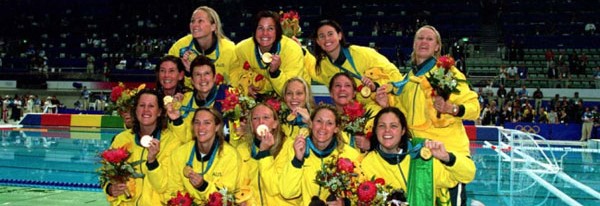
In 2000 at the Sydney Olympic Games, women’s water polo made its first official appearance at the Olympic Games, 100 years after the debut of this discipline. And Australia took its own slice of history…
AUSTRALIA’S INTERNATIONAL SUCCESS – WOMEN
The Australian women’s team took out the 1984 World Cup in Los Angeles, USA, and the inaugural World Championship in Madrid, Spain, in 1986.
In 1995, the team again reached the pinnacle by claiming the World Cup in Sydney, Australia, defeating five-time champion the Netherlands in the gold-medal final.
Late in 1997 the breakthrough for the women’s game with the ladies competition to be included in the 2000 Olympic Games program.
In the 14 months following the 1998 World Championships, the women won the four international tournaments they contested in the Netherlands, Italy, the United States and Hungary. They then went on to win the silver medal at the 1999 World Cup in Winnipeg, Canada.
At the Sydney Olympic Games, Australia lost only one game, to the Netherlands, on the road to securing the historic inaugural Olympic Games gold medal. That win galvanised the nation in the way in which it was won.
Yvette Higgins slamming in a nine-metre shot from a free throw with only 1.3 seconds left on the clock. In fact, the ball crossed the goal-line .2s from the final hooter. Captain Bridgette Gusterson was the equal highest goal scorer.
A change of coach from Istvan Gorgenyi to Greg McFadden brought new fortunes for the team after the Athens Olympics. The team collected a series of final appearances, winning the Commonwealth Championships in 2006 in Perth over Canada, winning the FINA World Cup in Tianjin, China (for a third time) in August of that year, finishing a goal down to the USA at the FINA World Championships in Melbourne in 2007 and later that year taking silver behind the USA at the FINA World League Super Finals in Montreal, Canada. The team also won bronze at the FINA World League Super Finals in Kirishi, Russia in 2005 while only coming fourth in Italy in 2006.
It was another bronze medal at the 2008 FINA World League Super Finals in Tenerife, Spain before going into the Beijing Olympics as a strong medal favourite. The team did not disappoint in a tight competition, facing and losing by a goal to the USA in the semifinals and then beating Hungary for bronze in a penalty shootout. Australia earlier drew with Hungary and only finished second in its group meaning the expected final clash with the USA came in the semifinals with the USA winning by a goal.
Championing Youth Water Polo in Brisbane
Explore vivid moments capturing the excitement and passion of young athletes competing at the championships.


